Advertisment

Advertisment
Showing posts with label IT Management. Show all posts

Saturday, 26 March 2016

Education for students through apple app


We’re making Apple devices as easy to deploy as they are to use.

New features coming this April will make the setup process simpler than ever. You’ll be able to get students and staff enrolled quickly, configure devices automatically, and easily buy and distribute apps and books.

Image result for apple education


Get your school up and running.

We’ve created a central system where technology managers can create accounts for everyone in the school, define roles and permissions, manage devices, and buy and distribute content in time for the first day of class.


PREVIEW

Apple School Manager

The new Apple School Manager is a simple, web-based portal that has everything admins need to deploy iPad and Mac in schools. Automatically create Managed Apple IDs for all students and staff, configure device enrollment settings, and easily buy and distribute apps, books, and learning materials. And you can log in from a web browser on any Mac or PC.

Apple School Manager Overview
Learn more

Built-in privacy.

Apple will never track, share, or sell student information for advertising or marketing purposes. We build powerful safeguards into all of our devices, operating systems, and services — including Managed Apple IDs, which are kept under the administration of your district. So the security, privacy, confidentiality, and integrity of student information is always protected. And we never track students or build profiles based on their email content or web browsing.

Managed Apple IDs

Managed Apple IDs are a new kind of Apple ID that gives students access to iCloud, iTunes U, and Shared iPad, while maintaining the control schools need. Apple School Manager lets you automatically create Managed Apple IDs for all students and staff by importing the necessary data from your Student Information System (SIS) or CSV files exported from your school’s directory service. And because Managed Apple IDs are owned and assigned by your institution, you can easily reset passwords, audit accounts, and define roles for everyone in the district.
We think Apple School Manager will save our tech staff lots of time — so we can manage devices, content, and our student accounts all from one place.
Patrick Scanlan
Supervisor of Technology & Information Services, San Jose Unified School District 

Image result for apple education


Set up devices automatically.

We’ve streamlined device setup for both one-to-one and Shared iPad environments.* Now you can wirelessly configure settings and restrictions according to your school’s requirements, then easily assign devices to students, teachers, or class groups.


Apple School Manager and your MDM work together.

You can set up and manage iPad and Mac wirelessly through your mobile device management (MDM) solution. Since your MDM and Apple School Manager work together seamlessly, you can automate setup and enrollment with the right settings and restrictions, then assign devices and apps according to the class groups you’ve defined.

Choosing your MDM solution.

Mobile device management solutions are available from a wide range of vendors, whether your school is better suited for a cloud-hosted environment or an on-premise server. MDM solutions come with different features and pricing, so you have flexibility in deciding how to bring Apple devices into your school.
PREVIEW

Shared iPad

Shared iPad is a new iOS 9 feature for schools that share devices but still want to provide personalized experiences.* Before class begins, teachers can assign any student any shared iPad. Students know which devices to use because their pictures are on the Lock screens. Students can access their personal content using a password or easy-to-remember four-digit PIN. And because data is locally stored on the devices, after they log in, their homework, apps, and assignments are exactly as they left them. So teachers and technology managers won’t lose time backing up or wiping data between classes.
Shared iPad will allow our district to transform a cart of shared devices into a personalized learning experience for each student.
Eric Culpepper
Technology Support Specialist, Goose Creek CISD


Get the right learning materials to the right classes.

Because all of your accounts, devices, and content are in sync, it’s easy for technology managers to provide classrooms with the right apps, books, and learning materials in time for the first day of class.


Buy in volume and distribute wirelessly.

When you purchase apps for iPad and Mac, your education volume discount is applied automatically. And as soon as you make a purchase, it’s simple to use your MDM to push apps and books to the classes, teachers, and students who need them.

Classroom App

Classroom is a powerful new iPad app that helps teachers guide learning, share work, and manage student devices. Teachers can launch a specific app, website, or textbook page on any device in the class, or share student work on a TV, monitor, or projector using Apple TV. They can even reset a student’s password, see which apps students are working in, and assign a specific shared iPad for the class period. The Classroom app is easy to set up on a teacher’s iPad with the help of MDM. And since it uses Bluetooth and Wi-Fi to connect to each student’s iPad, classes can get right to learning without requiring daily support from IT.
View Classroom in the App Store
We feel that IT should be hands-off as much as possible. Teachers need control — now they’ll have more power to manage their technology which reduces support from our IT staff.
Blair Anderson
Technology Director, Shawnee Heights School

Compatible with standardized testing platforms.

iPad is an approved device for securely administering summative exams, including state standardized tests from the Smarter Balanced Assessment Consortium (SBAC), the Partnership for Assessment of Readiness for College and Careers (PARCC), and ACT Aspire. By working with your MDM, you can configure devices for autonomous single-app mode and disable certain features for tests, making iPad a great tool for both formative and summative assessments.

Assessments Overview
Download PDF

Deployment Resources


Apple School Manager Help
Learn more

Classroom Help
Learn more

Getting Started with Classroom
Download PDF

iOS Deployment Reference
Learn more

OS X Deployment Reference
Learn more

Profile Manager Help
Learn more

Apple Configurator Help
Learn more

Education Deployment Guide
Learn more

Educational Technology Resources Database


In today's world, technology is ubiquitous. New opportunities and ways to integrate technology into the learning process are being created every day. Bringing technology into the classroom serves not only a tool, but also a resource for accessing information that further enables learning. In an age where the ways to integrate technology into the classroom are endless and daunting, New Horizons for Learning aims to evaluate technological methods and devices in an effort to provide educators with an efficient resource database that is teacher-tested.

We are just beginning the process of developing this Educational Technology Resource Database.
As we develop and evaluate resources,turn to this page for up-to-date, valuable ways to incorporate technology into your classroom.

Educational Technology Resource Database Volunteer Opportunity

Help us help you.
Our users visit this site from all over the globe and bring a wealth of experience. As we move forward with this initiative, our users will be the key to this project's success. After all, whose reviews would you trust? Most likely motivated teachers, with experience in your subject area, who have tested the educational technology resources in their classrooms. Please consider applying for one of the volunteer opportunities below, submitting a resource you would like our team to review, or sharing your experiences with a technology resource that has made a difference in your classroom or school.
  • Educational Technology Reviewer
    New Horizons for Learning is in need of reviewers in six subject areas: English, Fine Arts, Foreign Languages, Math, Science and Social Studies. Reviewers will be asked to try educational technology resources in their classrooms and evaluate their effectiveness and efficiency while providing valuable tips for user implementation. Reviewers will work in online teams, coordinated by a subject consultant, to produce these evaluations of tested resources for the database. Strong writing skills, content knowledge, ability to meet deadlines, and an interest in educational technology are musts. Most importantly, interested applicants should be genuinely interested in contributing their voice to help New Horizons develop a database to increase the ease and efficiency with which their colleagues can access resources to aid educational technology implementation.
For more information, please email nhfl.edtech@gmail.com with your desired position, subject area, and educational background.

Here you can view coming attractions for a search engine to solve math equations, discover a program that allows teachers to explore the depths of the ocean on a boat and communicate observations to their classrooms, and even learn from students working in teams to plan space flights.

Articles on Education Technology:

  • The Weak Signal of Mobile Governance
With technology making society increasingly interconnected in what many have come to call the ?Connected Age,? in what ways will we require a new system of representative democracy? Rick Smyre explores this question in his article The Weak Signal of Mobile Governance found here:
http://www.futuretakes.org/issues/fall_winter2009_2010/vol8no2/article_002.html
Rick is a professional futurist, President of the Center for Communities of the Future (http://communitiesofthefuture.org/), email:RLSMYRE@aol.com
  • Socioeconomic Status Predicts Hemispheric Specialization of the Left Inferior Frontal Gyrus in Young Children

    Raizada, R. D., Richards, T. L., Meltzoff, A. M. & Kuhl,P. K. (2008). Socioeconomic status predicts hemispheric specialization of the left inferior frontal gyrus in young children. NeuroImage, 40, 1392-1401.
    http://ilabs.washington.edu/kuhl/pdf/Raizada_etal_2008.pdf
  • Foundations for a New Science of Learning
    Meltzoff, A. N., Kuhl, P. K., Movellan, J., & Sejnowski,T. J. (2009). Foundations for a New Science of Learning. Science, 325, 284-288. Can be found through subscription to Science Magazine: http://www.sciencemag.org/


New Innovations and Programs for Teachers and Students:

  •  http://www.onlineteachingdegree.comThe project is a general information website with many resources useful to current individuals involved in the education industry. The site also discusses the offline and online educational paths one can follow to obtain a degree in education or a related field. Thank you for sharing this resource with us, Veronica Jensen!

     
  • WolframAlpha Answer Engine
    Have you ever wanted to put math or science equations into Google and receive the answer and explanation within seconds? This new type of search engine does just that! Though it is not running just yet, this introductory video will give you a good overview and more information. Get excited! http://www.wolframalpha.com/screencast/introducingwolframalpha.html
  • The Neptune Project

    This program takes teachers on the boat as they explore the ocean depths and the teachers communicate what they are seeing back to the classrooms
    http://www.neptune.washington.edu/
  • The Aerospace Scholars Program at the Museum of Flight in Seattle
Students work in teams to plan space flights to distant planets.
http://www.museumofflight.org/
http://www.newhorizons.org/strategies/technology/dunbar.htm
  • Ashoka's Youth Venture: Everyone a Changemaker
Students have the opportunity to develop local projects that may turn into nonprofits funded through this program.

JHU CTYOnline Mobile Learning Videos

At the Johns Hopkins Center for Talented Youth, students enrolled in the CTYOnline program can access their course materials through mobile devices. These courses feature videos, interactive exercises, quizzes, discussions, blogs, and other features, most of which work reasonably well for mobile users.  Figure 1 shows a video of a critical reading course for elementary students, using the Motorola Android phone, the Flash-based interactive glossary word game is accessible, including sound effects.
Figure 1: Quests and Challenges using the Motorola Android phone
Figure 2 shows some examples of mobile access to the Computer Security Fundamentals course, for students in grade 7 and up, using the Safari browser on the iPhone.  The touchscreen interface is intuitive to use and responsive, but clicking on one of the Flash-based lectures results in a white screen. 
Figure 2: Computer Security Fundamentals using the iPhone and Safari browser 
For Droid users, these videos appear, though load time will vary (Figure 3).  Entering text using either the onscreen or physical keyboard is time consuming, though not impossible for short phrases.
Figure 3: Computer Security Fundamentals using Motorola Droid 
The road ahead for m-learning is bound to be bumpy, but mobile phones are already in most teachers’ and students’ hands -- and their hearts, as well -- so the journey may be shorter than we think.
-Excerpt from an article in our Winter 2011 Journal: M-Learning: Promises, Perils, and Challenges for K-12 Education

Tuesday, 1 March 2016

Does your school have a growth mindset when it comes to change?

Want your tech rollout to be successful? First, you need the right mindset

Most educational organizations want to improve teaching and learning by leveraging technology. The terms blended learning and its subset, flipped learning, are touted extensively as useful educational goals.
However, there are a number of fundamentals that need to be in place in order to increase the likelihood of organization wide success. This contrasts with the success of the “lone experimenters”; the innovators and early adopters who will implement change no matter what the environment is like.
Fundamentals fall into a number of categories. I will consider one — mindset — in this article. Two previous articles examined infrastructure and leadership.
Believe it or not, there are some mental attributes required for change in the classroom to occur successfully. This is not an exhaustive list, but it contains some major points.
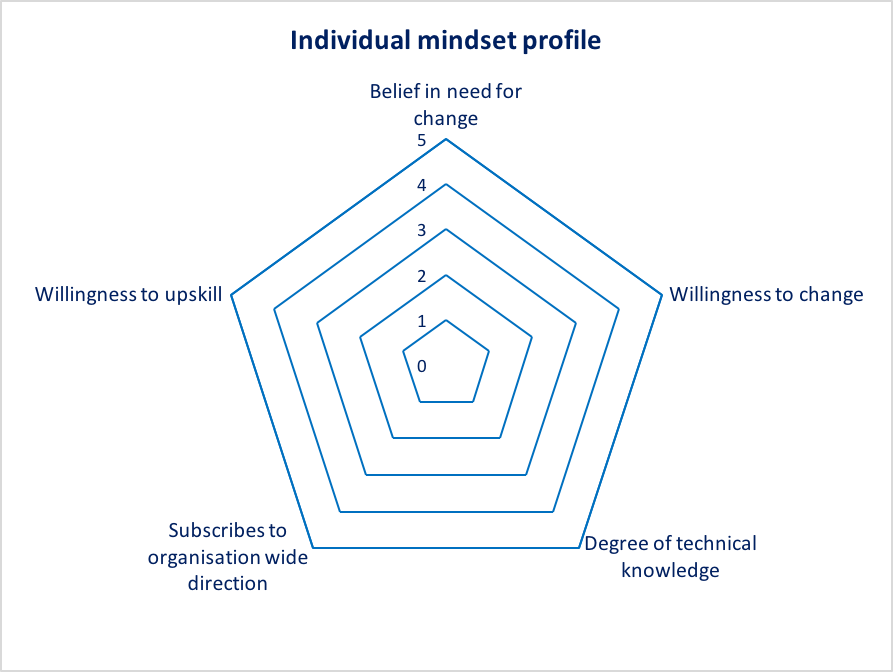
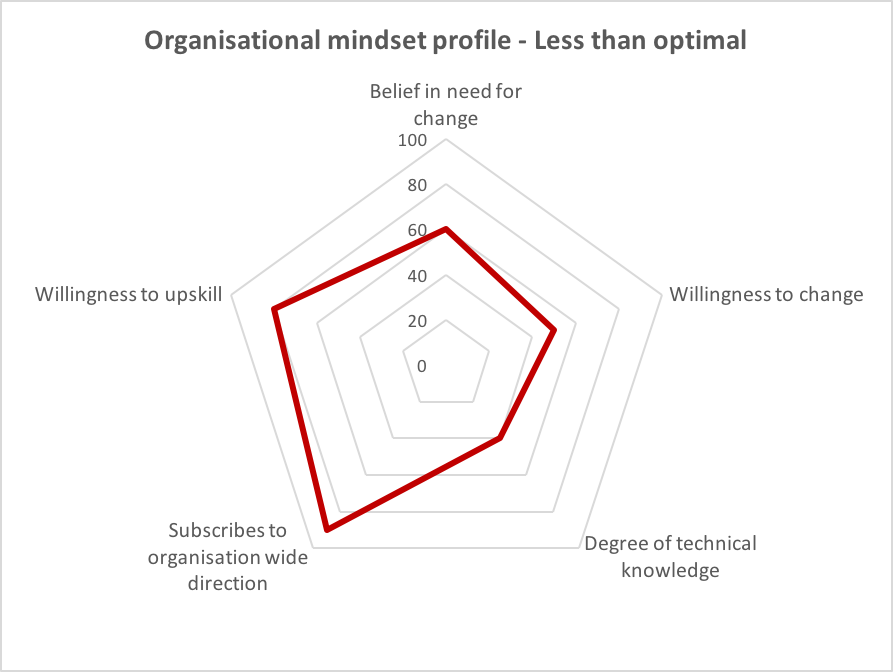
While reading these points, rate yourself, and then your perception of the total “mindset position” of your organization, on a scale of 1 (Poor) to 5 (Excellent). This may not be easy, but all that is needed is a “gut feel.” When you read the points, plot your results on the following graph.
org-chart
  1. Belief that education needs to change
    1. Does the person believe that some educational practices that have worked in the past need to change in order to enhance learning? If so, there is something to work with and change is more likely to occur.
    2. If the person believes that traditional teaching approaches have worked well for them in the past, and nothing needs to change, then it is less likely that discussion of and training in alternative approaches will actually create changes to methodologies.
  2. Willingness to change; to move beyond traditional approaches
    1. Even a person who believes that education needs to change has to then be willing to change.
    2. The person has to be prepared to set aside time to improve skills and understanding of what is required.
    3. As an example, many people believe they need to become fitter, yet are not prepared to act on this belief by actually taking part in a fitness program.
  3. Degree of technical knowledge and understanding of technology
    1. Leveraging technology to enhance learning requires a reasonable understanding of technology.
    2. It also requires a reasonable skill set.
    3. People with a reasonable depth of understanding and a range of skills can efficiently update their skills and approaches to learning.
    4. People with a limited skill set and level of understanding have a lot to “catch up” in order to leverage change successfully.
  4. Subscribes to organization wide direction
    1. How well does the person accept the need for organization wide guidelines? (As compared to “I will do what I want to do”.)
    2. Consistent and structured organization wide change has an opposite – ad hoc change by individuals. As is often the case, there needs to be a combination of the two. An organization needs consistent change within certain organization wide guidelines, while still encouraging the “experimenters” to flourish.
    3. As an example, many franchises are successful as they have clear organizational guidelines that all must adhere to. Owners have some latitude within these guidelines.
  5. Willingness to upskill/get involved in professional development
    1. Is involvement in professional development and training programs taken willingly and with reasonable enthusiasm, or is it something that has to be done because it is mandated or expected?
    2. People who are involved and reasonably enthusiastic are likely to implement the changes; people who attend because the “have to” are less likely to implement change.

An individual

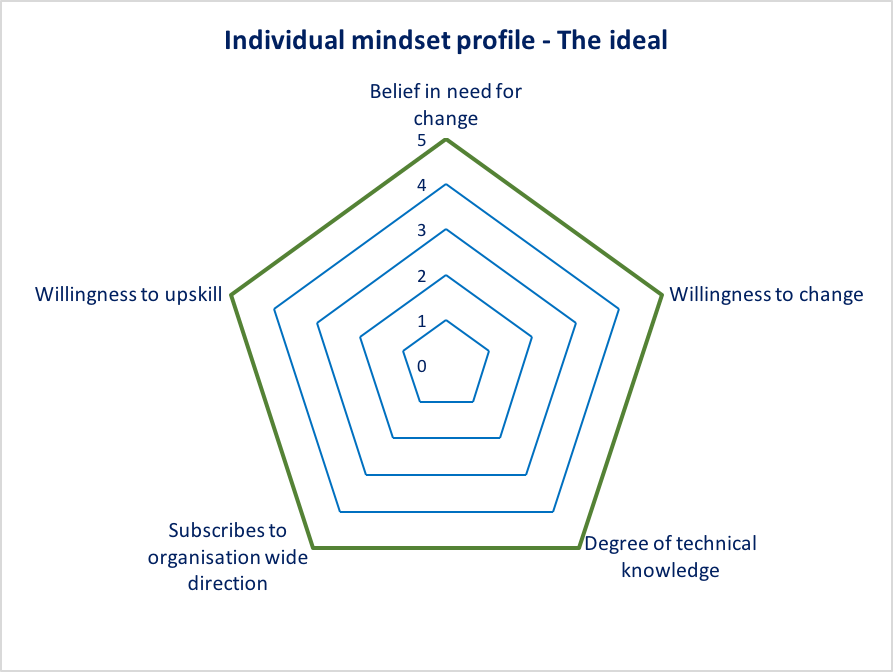
A person with a mindset ready to support change in the classroom would score 5 in each of these areas. The resulting graph would look like this.
Mindset Graph 2 - individual - Peter West
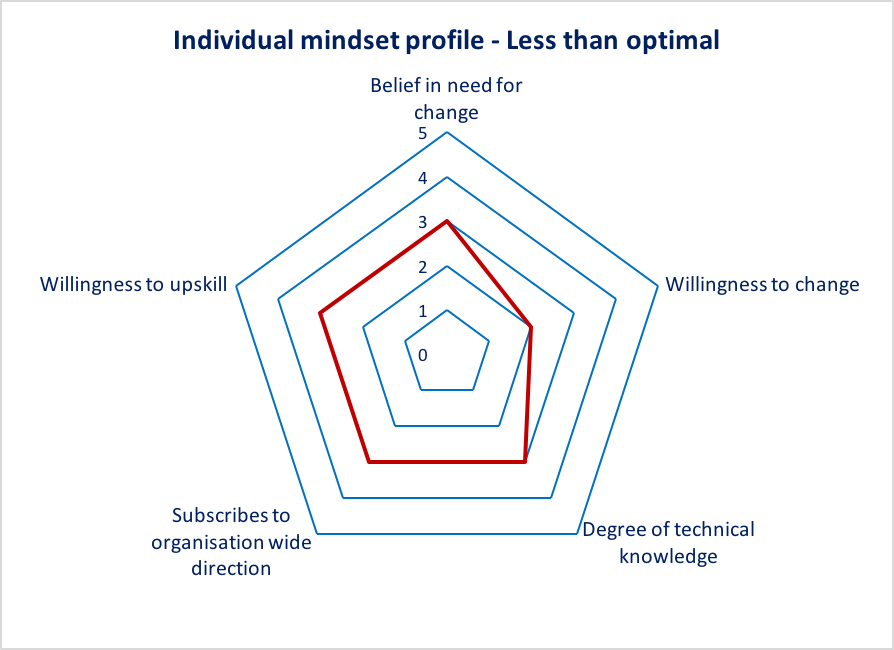
A less than optimal result follows.
Mindset Graph 3 - individual - Peter West

The total mindset component of the organization

While the previous graphs are for an individual, a graph reflecting the “total mindset state” of an organization would be similar. As mentioned, these ratings are a “gut feel” and may not be accurate, but they would provide an indication of the readiness of the human component of your organization.
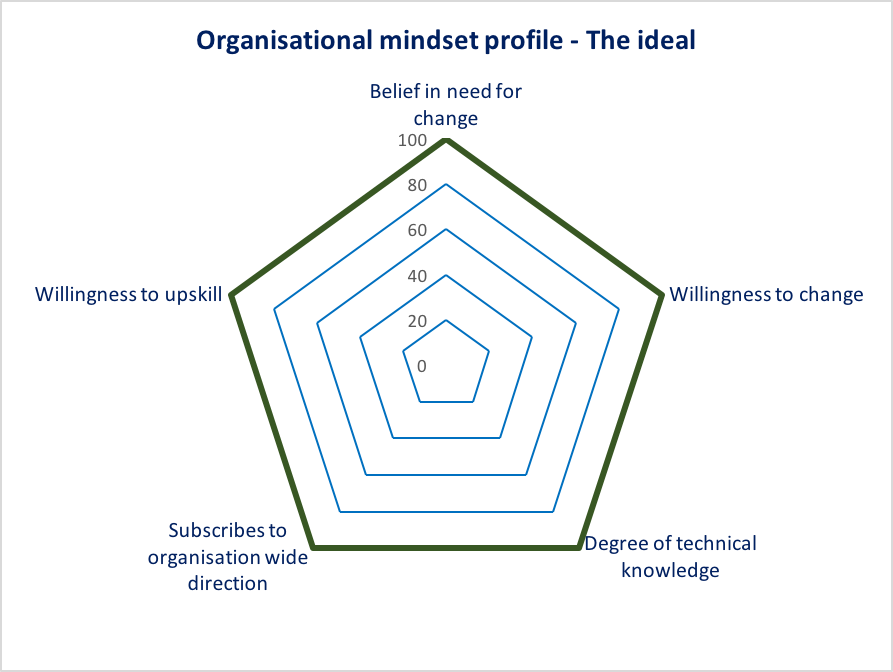
Instead of a 1 to 5 scale, we can use a percentage scale. If 100 percent of your staff would rate a 4 or 5 on the points raised in this article, your organization is in an enviable position and the graph is shown below.
org-chart-five
A less than optimal graph is shown next.
Mindset Graph 5 - organization - Peter West

Change is a human situation

Of the three areas covered in this series of articles to date (infrastructure and leadership are explained in previous articles), the mindset component necessary for organization wide change is the most difficult to come to terms with. There are a number of issues.
  1. We need to first become aware that the move to change educational practice by leveraging technology eventually becomes a human situation, not a technological situation. Once all of the appropriate technology is in place, it is the people and their mindsets who will make the changes work.
  2. Once we become aware that the evolution of education requires people, we need to find some way to determine who is prepared for the journey from traditional practice to pedagogies that positively leverage technology.
  3. Change can be uncomfortable and it may create anxiety and tension in some individuals. Thus, we need to find some way to either assist staff that rate a 1 or a 2 on some of the characteristics mentioned to change to a 4 or 5, or we need to assist them transition to an environment that suits their characteristics.
    On an organizational level, failure to do this reduces the pace of change or creates pockets of innovation along with pockets of resistance to change. On an individual level, it can produce tension, frustration and stress.
The well planned, well researched, structured and thoughtfully implemented introduction of technology can positively transform learning, and being aware of the factors that impact this implementation is essential for success to occur.

2016 math gaming competition kicks off

math-gaming

EdGaming math competitions can be a driver for engaging students

Educational games developer DimensionU has launched the 2016 Spring Tournament Season for its DimensionU Math Video Game Competitions in partnership with a variety of local education agencies and STEM Outreach organizations.
Math-based video game competitions provide a compelling environment to support student learning across a broad range of skill levels, offering the opportunity, regardless of academic background, for students to participate and achieve academic success.
The spring tournament season kicked off this month in Dallas Independent School District at its annual STEM Day event on February 6, 2016.
The tournament season slate continues with math competitions in the following locations:
Honolulu, Hawaii – Fort Lauderdale, Florida – Charleston, South Carolina – Champaign, Illinois – Rome, New York – Huntsville, Alabama – Picatinny, New Jersey – Tampa, Florida – Garland, Texas – Washington, D.C. – Austin, Texas – Fort Worth, Texas – New York, New York.
The competitions are typically conducted as live physical events involving elementary, middle, and high school students under a team-based and/or individual-based structure with curriculum differentiated according to a student’s current grade or performance level. This unique feature of the DimensionU Gaming platform, combined with its action-oriented game format, enables and fosters participation among a more inclusive base of students.
“Aside from educational excitement, what is most significant about our competitions is that they can be a key to unlocking the academic potential in students who may otherwise not be engaged in the classroom,” said Steven Hoy, CEO of DimensionU. “ We are creating positive change for many students and lighting a path towards the opportunity for higher education by establishing educational success through non-traditional means,” added Hoy.
DimensionU games are available to individuals, classrooms, schools, after school programs and school divisions via web, mobile and desktop applications and are usable cross-platform. The DimensionU competitions are scalable from classroom to national levels in both virtual and physical environments.

StoryBots launches interactive resources for teachers

interactive-resources

Books, videos, math games aim to boost student engagement

JibJab Bros. Studios launched an expansion of its StoryBots franchise with StoryBots Classroom, a free resource for educators that includes hundreds of videos, books and activities for use on interactive white boards, tablets and laptops in the classroom.
The product also includes the newly released StoryBots Math Skills, an extensive collection of kindergarten-level, standards-aligned math games and lessons.
Teachers can gain free access to the platform by applying for the StoryBots Educator Network at www.StoryBots.com/educate.
By pairing leading educators and learning experts with JibJab’s world-class team of artists and storytellers, StoryBots has captured the attention of today’s media-savvy students with fun, compelling content designed to support the development, practice and mastery of foundational skills. Today, over 9,000 teachers around the world are part of the StoryBots Educator Network.
“StoryBots is exactly what kindergarteners need! It is fun, engaging, uplifting, auditory, interactive and educational, all in one,” said Kelly Wade, kindergarten teacher at Collins Elementary in Grand Rapids, Michigan. “We use StoryBots daily in my classroom — from whole class warm-ups, to small group differentiated practice, to one-on-one remediation.”
Launched by JibJab Bros. Studios in 2012, StoryBots leverages JibJab’s Starring You personalization technology to allow kids to see themselves dancing and singing along onscreen next to their favorite StoryBots characters. Since its founding, StoryBots videos have amassed more than 300 million views online, while its eBooks have been read more than 8 million times.
“As new parents, my brother and I saw the opportunity to leverage technology and storytelling to accelerate learning and help kids get ahead,” said Gregg Spiridellis, StoryBots co-creator and CEO. “We’re thrilled to make the entire StoryBots library available to all young learners in classrooms for free.”
StoryBots Classroom offers an expansive new suite of classroom-ready activities and resources, including:
  • Math Skills – Common Core-aligned kindergarten-level math games
  • Learning Videos – a library of 110+ animated musical videos that explore a wide range of topics
  • Starring You® and Learning Books – 90+ eBooks that help kids practice reading
  • Starring You® Videos – offering fun, quick and personalized reward for the classroom and can be used for brain breaks
  • Activity Sheets – 20 printable books and 350+ sheets for teachers to use in their classrooms
  • Teacher Tools – including Class Roster, Lesson Planner, Group Builder — to help educators manage their classroom and create custom plans to best suit their students’ unique needs

Tuesday, 8 December 2015

3 barriers, 3 fixes for school broadband

A new report urges state leaders to help all school districts access high-speed school broadband

school-broadbandNationwide, 23 percent of school districts still do not meet the Federal Communication Commission’s (FCC) minimum school broadband access goal of 100 kbps per student, according to a state-by-state broadband connectivity report from the nonprofit EducationSuperHighway.
The top three barriers to meeting the FCC’s minimum school broadband goal, according to the report, include:
  • Access to fiber: School districts without fiber are 15 percent less likely to meet connectivity goals.
  • Broadband affordability: Districts that do meet the 100 kpbs per student minimum pay an average cost of $5.07 per Mbps–those that do not meet the goal pay more than double, at $12.33 per Mbps.
  • School district budgets: The average internet access budget in districts that meet the FCC’s connectivity goal is $4.93 per student–more than 2.4 times the $2.08 per student budget for districts that do not meet the school broadband connectivity goals.
In all, 20 million more students have been connected to high-speed broadband over the past 2 years, according to the report. In 2013, just 30 percent of school districts met the Federal Communication Commission’s minimum school broadband access goal. In 2015, that jumped to 77 percent.

Despite meeting connectivity goals, most districts still have to increase the amount of broadband they purchase in order to keep up with demand, which is growing in K-12 schools at a rate of more than 50 percent per year, EducationSuperHighway says. In fact, the typical school district will have to triple its bandwidth in the next three years.
Three things can help connect all of the nation’s students to school broadband:
  • Connect 9,500 schools to fiber: Twelve percent of schools that need a fiber connection do not have one, and EducationSuperHighway estimates it will cost roughly $1 billion to achieve connectivity.
  • Ensure every classroom has wi-fi: Districts can leverage the $3.4 billion in funding available for internal connections over the next four years to ensure every classroom has wi-fi.
  • Make school broadband affordable: Continually focusing on affordability, and striving to lower the cost of broadband access to $3 per Mbps, would help 12.2 million students meet the FCC’s minimum access goal. If remaining districts invest $0.25 per student per year, every student would be able to meet the FCC’s minimum goal.
“Digital learning has the power to transform education in this country, but that can’t happen without
first connecting all of our students to high-speed Internet. By working together to put a broadband
foundation in place, we can ensure that every student, in every state has equal opportunity for a world-class education,” said Evan Marwell, CEO of EducationSuperHighway, in a press release about the report.
To access information about your specific state, click here for a list of all states, and click here for an interactive tool.

How to save money and time with asset management software

Asset management software is keeping track of textbooks and more for districts

textbooks-assetsTwo years ago Consolidated Unit School District 300 in Algonquin, Ill., was facing a pretty daunting challenge across its 26 schools. When it came to recording the inventory of assets like textbooks, some of the district’s numbers were incorrect. “We’d start a new school year thinking that we had the appropriate supplies for our students, only to find out that our inventory system didn’t reflect what we actually had on hand,” said Susan Harkin, chief operating officer for the 26-school, 21,000-student district.
A student who wasn’t matched up with an algebra book, for example, would often have to wait a week or two for it to be ordered and delivered to the classroom. And for some of the outdated books that are no longer being published, the district could spend months trying to hunt down the textbooks. “Students would start the school year without a textbook to refer to for homework,” said Harkin. “It wasn’t a good situation for a district that’s focused on student success.”
Harkin says the schools’ curriculum and instructional personnel were particularly concerned about the gaps that existed between the inventory system and the actual inventory. At the time, D300 was most concerned about textbooks, although it also wanted to improve the tracking of district-owned assets such as tablet computers and musical instruments.
Finances were another driver, says Harkin, who notes that her district spends $2,500 less than the state average per student. “Assets and resources are tight,” she added, “so everyone wants to do his or her part in helping to make sure we’re using our resources efficiently and effectively.”
A district-wide initiative
asset-managementWhile searching for a solution to its asset management problem, the district found one possible answer right in its own educational technology stable. Already using Follett Learning’s Destiny Resource Manager, the district started leveraging the platform’s physical inventory capabilities. Using the web-based system, teachers and administrators can view current inventory levels and locations, manage the inventory, and more efficiently plan for resource expenditures. They can also reallocate assets to different schools, thus reducing redundancies and stockouts.
Harkin’s team began by conducting a complete asset inventory. The process was handled by a dedicated team of staff members for whom “the management and movement of those assets” were part of their part of their job duties, she said. Finally, the district installed a new staff person to oversee asset management from the central office and coordinate the process across D300’s 26 schools.
As a component of the physical inventorying process, D300 weeded out books that weren’t part of its curriculum. “Why track assets that don’t matter to us anymore?” Harkin asked. In addition, the district shifted its textbook ownership philosophy from “building level” to “district level.” Because textbooks are now a district item, if a building has an overstock of 100 books, those assets can more easily be moved to another school as needed.
On the financial side, Harkin estimates that the district saves “a couple hundred thousand dollars per year now,” with most of the savings coming from its ability to more accurately track assets across its schools. In the past, for example, institutions with growing enrollment numbers would simply buy textbooks, not knowing that another school with declining enrollment numbers had the needed assets sitting in its storeroom.
“In the past, schools would hold onto them because they already paid for the books and didn’t want to give them up,” said Harkin. “By taking ownership across all of our schools, we’ve been able to make asset management a true, district-wide initiative that everyone is now onboard with.”
No more paper and faxing
With 230 schools and over 150,000 students, Dallas Independent School District relied on an antiquated asset management system that resided at the district office and accommodated just four user logins. When they needed textbooks, teachers would have to fill out handwritten forms and fax them to the office, where someone else would input the information and place the order. And while the previous system was used to maintain inventory, the fact that only four people could access it made it cumbersome and far from collaborative.

“We needed a new solution to bring us into the modern times,” said Matt Tyner, manager of textbook services.

Other asset management challenges plaguing the district included a lack of system data, no automation, and low visibility over textbook inventory across its many campuses. “My predecessor had been here for 25 years, so when I came onboard in 2011 it was definitely time to automate and streamline these largely manual processes,” Tyner said.
After putting out a request for proposal (RFP) that attracted bids from two different software vendors, Dallas ISD decided to implement a textbook inventory management solution from Hayes Software Systems. Key criteria included a system that would provide the district with real-time data and that would offer a district-wide platform that all parties could use via any internet-enabled device or computer. “We needed something that would replace the phone calls we were getting on every single issue and question,” said Tyner.
Functional capabilities
Dallas ISD’s textbook inventory management solution handles functions like the requisition of instructional materials, the return of instructional materials to the warehouse, campus textbook inventory, a repository for lost and used books, and an easy way to transfer materials among campuses. All of the activities take place online and can be access 24/7 on an as-needed basis.
According to Tyner, the system has helped the district improve its inventory tracking and real-time accountability — two things that were largely handled on a manual basis before 2011. “Our teachers and principals really had to jump through hoops to find their books, write up their orders, fax them in, and then monitor the order progress,” said Tyner. “This is just a much simpler way to get all of that done.”
To districts that are struggling to get a handle on their school-owned assets, Harkin said the first step is simply admitting that this is one of the “hidden issues” that isn’t always talked about or discussed — but it does exist and can be both expensive and time consuming. “If you really want to be responsible with your textbooks, you have to admit that you have a problem and that you’re willing to tackle it collectively,” she said. “It may require an initial investment in time and money, but if you keep ignoring the problem it’s only going to get worse.”
Bridget McCrea is a contributing writer for eSchool News.